Not financial advice. Do your own research. This site is education only, and you can lose everything you put in. Read the full disclaimer.
A bigger chain means a bigger bill for everyone who checks the rules themselves. Here is how big BTC and XBT are today, how big they could be in 5, 10 and 20 years, and what it means for fees, home nodes and phones. Both sides of the argument are included.
The short answer
- Today the two chains are almost the same size. BTC is about 786 GB of block data and XBT is about 764 GB (an estimate, see the notes below). They share all history up to August 2026, so XBT is only about 23 GB (3 percent) smaller.
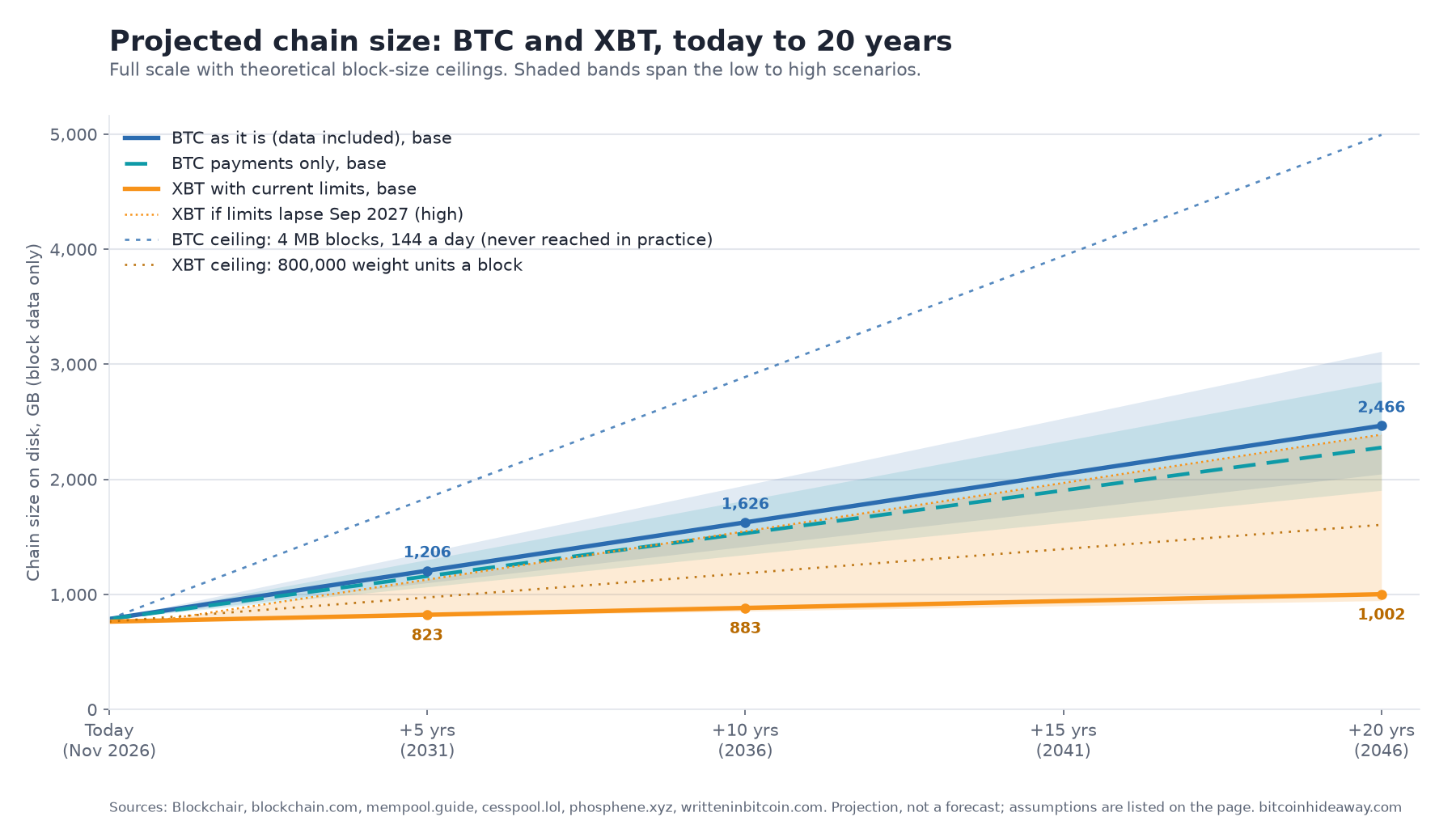
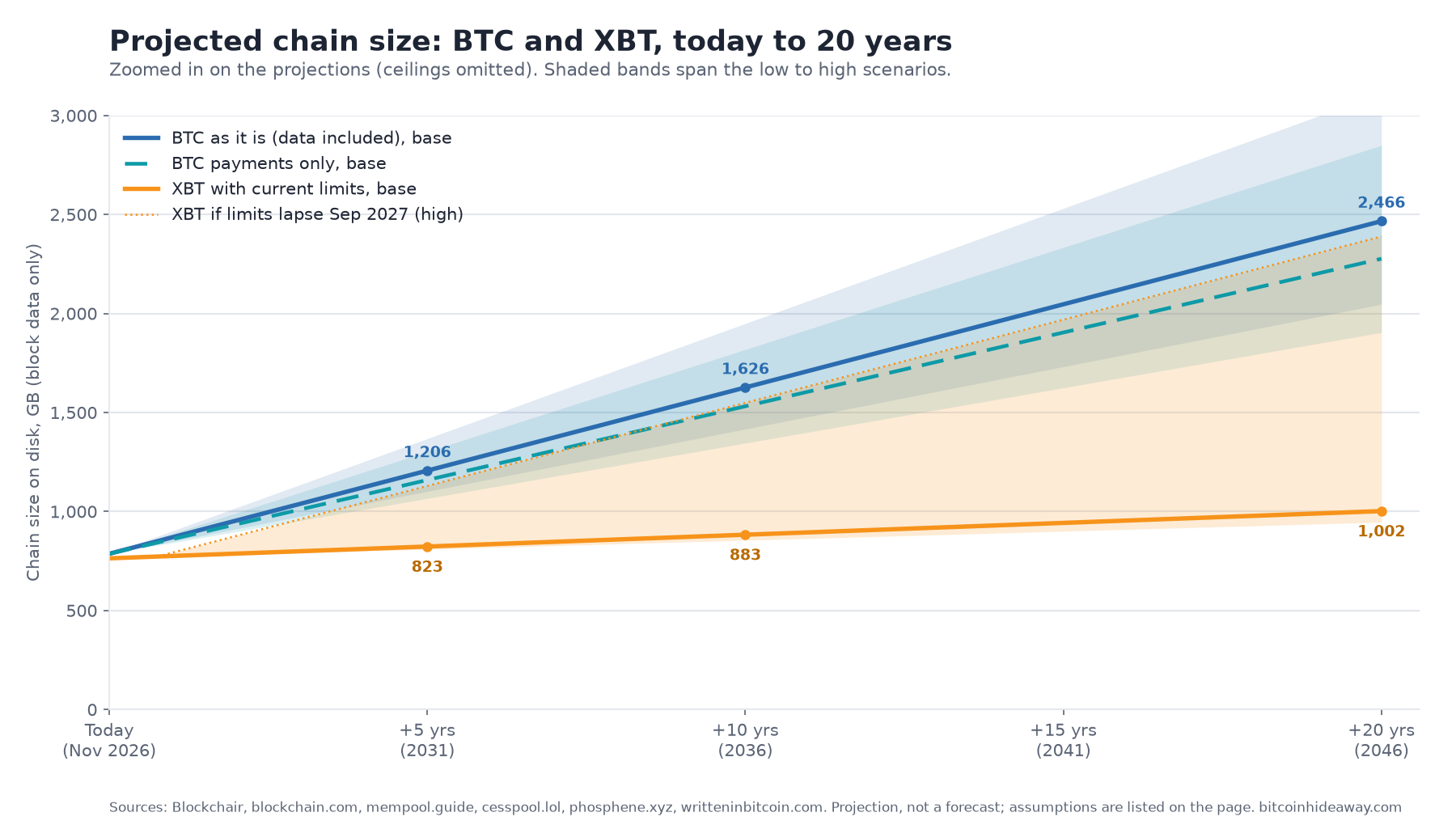
- The difference is the future. Since the split BTC has grown by about 26 GB and XBT by about 3.4 GB. In the base case BTC reaches about 2,466 GB in 20 years and XBT about 1,002 GB.
- XBT’s saving comes from a small block cap, not from keeping data out. Cesspool.lol grades 23.5 percent of XBT block weight in November as non-payment data, close to the 34 percent measured on BTC. And the cap is temporary: it is set to end on 1 September 2027 unless node operators keep it.
- Removing all data from BTC would not shrink it much. Measured as raw data bytes, non-payment data is only about 10 to 11 percent of what BTC stores. Counted as whole data-carrying transactions, it is about a third of block space.
The chart
Chain size on disk in gigabytes (decimal GB, block data only, no indexes). Shaded bands run from the low to the high scenario.
The numbers (GB)
| Chain and scenario | Today | +5 yrs (2031) | +10 yrs (2036) | +20 yrs (2046) |
|---|---|---|---|---|
| BTC as it is, low | 786 | 1,101 | 1,416 | 2,046 |
| BTC as it is, base | 786 | 1,206 | 1,626 | 2,466 |
| BTC as it is, high | 786 | 1,368 | 1,949 | 3,112 |
| BTC payments only, low | 786 | 1,066 | 1,345 | 1,904 |
| BTC payments only, base | 786 | 1,159 | 1,532 | 2,277 |
| BTC payments only, high | 786 | 1,302 | 1,818 | 2,850 |
| BTC base, if all whole data-carrying transactions were removed | 786 | 1,064 | 1,341 | 1,895 |
| XBT, low (limits kept, data filtered) | 764 | 809 | 855 | 946 |
| XBT, base (limits kept, current mix) | 764 | 823 | 883 | 1,002 |
| XBT, high (limits end Sep 2027, BTC-like fill after) | 764 | 1,129 | 1,549 | 2,389 |
| Ceiling, BTC (4 MB blocks, 144 a day) | 786 | 1,838 | 2,890 | 4,994 |
| Ceiling, XBT (800,000 weight units, 144 a day) | 764 | 974 | 1,184 | 1,605 |
The ceilings are the most the rules allow, not a prediction. No real chain has ever filled every block to the byte limit. Growth per year used: BTC low 63, base 84, high 116 GB; XBT low 9.1, base 11.9 GB (then 84 GB a year after September 2027 in the high case). BTC ceiling is 210 GB a year and XBT ceiling is 42 GB a year.
Where the figures come from
| Figure | Value | Source |
|---|---|---|
| BTC block data on disk | 786.5 GB on 28 Nov 2026 (block 977,919) | Blockchair stats API; blockchain.com gives 786.0 GB on 26 Nov |
| BTC full chain with undo data | 896.3 GB; chainstate (UTXO set) 11.66 GB; 162.6M unspent outputs | bitcoinstats.io, block 977,752 |
| BTC growth per year | 2020 to 2022 about 63 GB; 2023 92; 2024 89; 2025 84; 2026 about 84 at the current pace; fastest 4 weeks (Feb 2023) about 116 a year | blockchain.com blocks-size chart (my calculation from its data) |
| BTC data share, narrow (data bytes only) | 10.3 percent of 2026 block bytes (7.9 GB of 76.2 GB); 6.06 percent of all history (47.7 GB of 786 GB); Ordinals inscriptions 39.9 GB in total | writteninbitcoin.com |
| BTC data share, other measures | 11.3 percent of stored bytes are non-monetary data; 33.98 percent of block weight goes to data-carrying transactions; they paid 24.26 percent of fees at 1.86 sat/vB against 2.99 for payments | phosphene.xyz tracker, 31 Mar 2025 to 10 Nov 2026 |
| BTC OP_RETURN share of block weight | 4.2 percent on 20 Nov 2026 | CryptoKeyhole |
| BTC blocks are full | The 15 latest blocks I checked were 99.8 to 100 percent of the 4,000,000 weight limit, and 1.1 to 1.75 MB each | mempool.space API, 28 Nov 2026 |
| XBT split point | Shared history to block 961,631, then 8 stalled SHA-256 blocks, first BLAKE2b block 961,640 on 30 Aug 2026 | xbt.live, BIP-110 |
| XBT chain size now | About 764 GB. This is my estimate: BTC size at the split (760.1 GB, interpolated from blockchain.com) plus the 8 stalled blocks (0.01 GB) plus 3.4 GB for 22,263 blocks since, from a 38 percent sample of block sizes | mempool.guide API; block counts from cesspool.lol |
| XBT block size now | Average about 227 kB in the last 4,300 blocks, largest seen 716 kB; about 142 blocks a day in November | mempool.guide sample; cesspool.lol |
| XBT temporary limits | About 300 kB per block and 800,000 weight units until 1 Sep 2027, then they end unless node operators continue them. BIP-110 also caps data pushes at 256 bytes and OP_RETURN at 83 bytes | bitcoin-blake2b.org, BIP-110 |
| XBT non-payment share | By block weight: August 3.09, September 5.14, October 38.78, November 23.49 percent; last 24 hours 31.9 percent; 14 of 121 blocks fully clean. 977 MB of such data in 161,194 transactions since the split. Graded by the Plumb 16 node policy; stock Knots refuses 82.1 percent of it | cesspool.lol (see its monthly page). It is a strict yardstick, so treat the percentages as the high end |
How the projection works
- Start from real sizes. BTC 786 GB and XBT about 764 GB today. Both grow in a straight line, because block size limits stay fixed and halvings do not change them.
- BTC growth. Low is the 2020 to 2022 pace before inscriptions, base is the last 12 months, high is the fastest 4 weeks on record, annualised. This is a judgement. Nobody can tell whether demand for block space will rise or fall.
- BTC payments only. Future growth is cut by the narrow data share, 11.3 percent. It leaves existing history alone. A second row cuts the whole data-carrying transactions, 34 percent, which is a lower bound on their share of bytes because inscription data is discounted by weight.
- XBT. Base keeps today’s average block size (227 kB) at 144 blocks a day. Low assumes miners also filter data and removes the 23.5 percent November share. High assumes the limits end on 1 September 2027 and XBT then fills like BTC does now. XBT’s actual demand is much smaller than BTC’s, so that is a stress case.
- Ceilings. BTC can never exceed 4 MB a block, which is 210 GB a year at 144 blocks a day. XBT’s cap is 800,000 weight units, which is at most 0.8 MB a block or 42 GB a year in the extreme. The project describes typical capped blocks as about 300 kB, which is 15.8 GB a year.
What a bloated chain means in practice
1. Sending a payment: fees, competition and waiting
- Blocks are full, so everyone competes. BTC blocks hold about 4 million weight units and recent ones were full. Whoever pays the higher fee rate goes first. Data transactions and payments bid for the same room.
- Quiet days are cheap. On 28 Nov 2026 Blockchair shows a median fee of about $0.01 and an average of about $0.36, with 60,796 transactions waiting in the mempool.
- Busy days are not. At the April 2024 halving, when Runes launched, the average fee reached $91.89 on 20 April against $3.35 in March, and one block collected 37.7 BTC in fees (about $2.4 million) (Forbes, Cointelegraph). It faded within days (CryptoSlate).
- Waiting. A payment that bids below the going rate can sit for many blocks (a block is about 10 minutes). You can pay more to jump the queue, which is the fee spike people complain about.
- The other side: in normal times data pays a lower rate than payments (1.86 against 2.99 sat/vB), so it mostly uses room payments are not bidding for. The fee spikes were short.
2. Running a full node at home
- Disk. BTC block data is 786 GB. A real Umbrel node in September 2026 used 907 GB in total: blocks 815 GB, chainstate 12 GB, transaction index 69 GB and filter index 13 GB. An Electrum server on top added 192 GB (Bitcointalk hardware thread). Plan for 2 TB.
- SSD or HDD. An SSD is the sensible choice. Fulcrum’s author says a mainnet index takes hours on an SSD and probably days on a hard disk. Blockstream says first sync on a hard disk takes days or weeks.
- First sync (IBD) time. A fast desktop with an SSD takes about 6 to 12 hours. A Raspberry Pi 5 with fast storage takes about 3 to 5 days, and a Raspberry Pi 4 can take 7 to 14 days or more (Spark benchmarks). A Core developer measured about 22 days for an ordinary pruned sync on a Pi 4 with 2 GB RAM (bitcoin#36476).
- Bandwidth. A new node downloads the whole chain once. After that, Bitcoin.org says about 20 GB a month down and often 200 GB or more up if you serve other nodes (Bitcoin.org). Blocks-only mode cuts this to about 150 MB a day down.
- RAM and the UTXO set. The UTXO set is the list of coins that can be spent. It is 162.6 million outputs and 11.66 GB, and it needs fast storage and cannot be pruned. It has actually shrunk by 25.6 million outputs since the December 2024 peak, though its size in bytes has risen (bitcoinstats.io, Spark). A hard-disk node wants about 12 GB of spare RAM for caching.
3. Cost in US dollars
Using today’s lowest-price listings on Amazon (23 Nov 2026): internal hard drives $33.33 per TB and M.2 NVMe SSDs $128.32 per TB (ratioDB). Prices held flat for the projection, which is a simple assumption.
| What you store | GB | Hard drive | NVMe SSD |
|---|---|---|---|
| BTC block data today | 786 | $26 | $101 |
| XBT block data today | 764 | $25 | $98 |
| Real Umbrel BTC node plus Electrum server (907 + 192 GB) | 1,099 | $37 | $141 |
| BTC block data in 20 years, base | 2,466 | $82 | $316 |
| BTC block data in 20 years, if blocks filled to the ceiling | 4,994 | $166 | $641 |
| XBT block data in 20 years, base | 1,002 | $33 | $129 |
| Pruned node (chainstate 11.7 GB plus about 2 GB of recent blocks, my estimate) | 14 | under $1 | $2 |
The raw drive is cheap. What costs more is the whole machine: a mini PC or Pi with a fast SSD, power, and days of syncing. Storage also did not get cheaper in 2026. Hard-drive and SSD prices were up about 134 and 129 percent in a year to September 2026. SSD prices have started to ease and are forecast to fall from the second half of 2027, while hard drives are expected to stay high until 2028 (Digital Today, VDURA, TrendForce).
4. Phones and light wallets
- A phone cannot hold the chain. At 786 GB it is larger than the storage on most phones (general knowledge, not measured here), so phone wallets are light wallets.
- Headers do not bloat. A light wallet follows only the 80-byte block headers. About 977,900 headers come to roughly 78 MB, and spam does not add to it (BIP 157, my calculation).
- Electrum and Fulcrum servers. Many wallets ask an Electrum-style server for their history. The server needs an index: roughly 100 to 192 GB on BTC depending on software and date (Spark, Bitcointalk). Fewer people can afford to run one, so most phones lean on someone else’s. That server sees which addresses you ask about, which is the privacy trade-off (Bitcoin Optech).
- Compact block filters (BIP 157 and 158). The phone downloads a small filter for each block, checks it locally, and fetches a whole block only when it matches. This hides your addresses better, but uses more bandwidth than Electrum, and a server can still guess from which blocks you fetch (Lightning Labs). Spam makes blocks bigger, so every matched block costs a phone more data.
- Lightning on a phone. Most Lightning payments do not touch the chain, so they are unaffected by block space. Opening and closing channels does, and in a fee spike that gets expensive. Mobile Lightning wallets generally depend on a light-client method or a trusted server to watch the chain (general knowledge).
- XBT. Its smaller blocks help phones. Its index servers are early and few. kilombino.com publishes an XBT Fulcrum snapshot of 155 GB at block 981,416. That is a different method and date to the 192 GB BTC figure, so do not compare them directly.
5. The tools that help
| Tool | What it does | What it does not fix |
|---|---|---|
| Pruning | Checks every block, then deletes old ones. Minimum setting 550 MB. A pruned node holds roughly 14 GB, mostly the UTXO set. | Still downloads and checks the full chain, so sync time is unchanged. Cannot serve old blocks to others. Cannot keep a full transaction index (Bitcoin.org), so Fulcrum-style Electrum servers will not run on it (Fulcrum README). Older guides say 5 to 7 GB, which is out of date now that the UTXO set is about 12 GB. |
| assumeUTXO | Loads a snapshot of the coin set so a new node is usable in minutes to a couple of hours while it checks history in the background. Mainnet support arrived in Bitcoin Core 28 (October 2024) (The Bitcoin Manual). | You trust the snapshot hash built into the software until the background check finishes. The full chain still lands on your disk unless you also prune. Not shown to exist for XBT in my research. |
| Compact block filters (BIP 157/158) | Lets light wallets find their payments without sending addresses to a server. | More bandwidth. Needs full nodes that build the filter index (13 GB on the Umbrel above). |
| Lightning | Moves many small payments off the chain. | Channel opens, closes and disputes still need block space and fees. |
| Umbrel-type home nodes | One box that runs the node, Electrum server and wallet apps. An Umbrel with an Intel N150 and SSD synced a pruned chain in about 5.7 hours in an early prototype test (bitcoin#36476). | Unpruned, it needs about 1.1 TB with an Electrum server, plus power and upkeep. Most XBT apps on Umbrel are unofficial and unaudited. |
| DATUM and home mining | Lets a miner build their own block template from their own node and choose which transactions go in. Run a filtering node and you can keep data out of your blocks (OCEAN, DATUM Gateway). | It works only if the miner chooses to filter. On XBT in the last 24 hours only 14 of 121 blocks were fully clean, even though many came from DATUM miners (cesspool.lol). The official OCEAN gateway targets BTC and says Knots after 29.3 no longer works with it. XBT pools such as CONVOY run DATUM on Knots (ctrlpool). |
The two sides, side by side
“Spam bloats the chain”
- Every full node stores every byte forever, and the people who pay for the data do not pay for the storage.
- Blocks are full, so data and payments compete, and fee spikes like April 2024 price out small payments.
- A bigger chain means longer first syncs, bigger drives, more bandwidth, and fewer people running nodes.
- Phones lean more on servers, which weakens privacy and pushes towards a few big providers.
- UTXO bloat is worst because it cannot be pruned and wants fast storage and RAM.
- XBT’s rules cap block size and large data pushes, so its worst-case growth is about five times lower than BTC’s (42 against 210 GB a year).
“It is fine”
- Anyone who pays the fee may use block space, and who decides what counts as spam is a judgement call.
- Data transactions paid about a quarter of fees (24.26 percent), and fees are the long-term pay for miners as the subsidy halves. Today fees are only about 0.8 percent of miner income, so data adds about 0.2 percent (my calculation from Blockchair).
- The size limit, not data, sets the growth. BTC grew about 84 GB a year in 2025 and 2026, and 92 GB in 2023. Taking out data bytes would cut only about a tenth of that.
- Storage is cheap per GB: the whole BTC chain costs about $26 on a hard drive today, and pruned nodes need about 14 GB.
- Header chains, pruning, assumeUTXO and filters mean light users and small nodes can still verify.
- XBT’s cap is temporary, its 23 percent non-payment share is similar to BTC’s, and its demand is tiny. A filter can be bypassed with data that fits the limits.
Caveats
- Data share is measured several ways, so there is no single true number. I show a narrow one (data bytes, about 10 to 11 percent of BTC) and a broad one (whole data-carrying transactions, about 34 percent of weight).
- The XBT chain size is my own estimate from a sample, not a node reading. The BTC figure is a block-data size and leaves out indexes and undo data, so a real node is bigger (about 896 GB with undo data).
- The cesspool.lol shares are graded by a strict policy (Plumb 16) that is stricter than the XBT consensus rules, and that site argues one side. They show how much data gets through, not that it breaks a rule.
- The project’s wording is “about 300 kB per block”, but I saw XBT blocks up to 716 kB, so the safe worst-case ceiling is the 800,000 weight limit.
- We could not find a measured XBT UTXO set size, XBT assumeUTXO support, or XBT sync benchmarks, so none are shown.
- Straight-line growth ignores a possible change in demand, fees or the rules. A future where data demand falls or rises sharply would bend the lines.
Method files (data, chart code and table) are kept with the site’s working notes. Education only, not financial advice.